There are places you visit, and there are places you enter slowly, as though they require a different pace of mind. La Orotava belongs to the second kind. It is not a town that overwhelms you with spectacle in the first five minutes. Instead, it reveals itself through proportion, texture, silence, and memory. Streets tilt with the slope of the valley. Wooden balconies cast shadow over whitewashed façades. Church domes rise where mist and sunlight keep changing the color of stone. In La Orotava, beauty is not an accident of tourism. It is the visible result of geography, trade, faith, craftsmanship, and centuries of patient urban life.

A town shaped by its valley
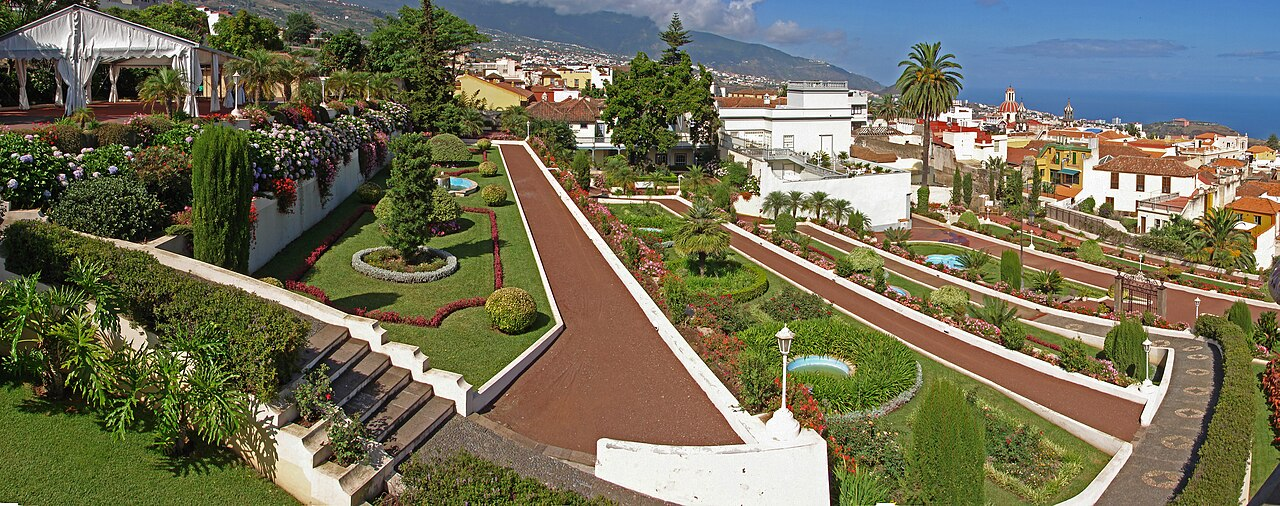
To understand why La Orotava matters, you have to begin with its setting. The town sits in the Orotava Valley in northern Tenerife, a landscape long associated with fertility, green slopes, and cultivation. Spain's official tourism site describes it as a historic town in a valley of banana plantations, while local tourism materials stress the way the urban core was shaped on a hillside, with its layout responding to water channels and mills that once ran through the town. La Orotava is not merely picturesque; it is a place where topography actively shaped urban form.
The town was founded after the Castilian conquest of Tenerife at the end of the fifteenth century, and it belongs to the first generation of towns created in the new political order of the island. Yet what makes it remarkable is not just its age, but its continuity. La Orotava is the only town in the Canary Islands with an almost entirely intact historic centre. The town feels less like a set of isolated monuments and more like a complete urban organism.

Casa de los Balcones and the language of wood
One of the most distinctive features of La Orotava is its relationship with Canarian domestic architecture. If you want to understand the town, you have to pay attention to houses, not just churches. The famous Casa de los Balcones is often treated as a postcard icon, but it is much more than that. The house was built around 1670 with the help of some of the finest carpenters of the time, with a large tea-wood balcony, interior patio, open verandas, and even an imposing wooden wine press.
The complex brings together Canarian craftsmanship, architecture, gastronomy, and culture across stately homes from the sixteenth and seventeenth centuries. The building is important not simply because it is photogenic, but because it condenses the social and material world of the town: woodwork, domestic organization, artisanal skill, and the wealth that made such houses possible.
Wealth, agriculture, and Atlantic exchange
That wealth did not emerge in a vacuum. Like much of northern Tenerife, La Orotava grew in a wider Atlantic world shaped by agriculture, landownership, and maritime exchange. The Orotava Valley was historically productive, and the town is connected to landholders, craftspeople, and an agricultural landscape whose prosperity fed urban refinement. Its architecture reflects not only aesthetic taste, but an economy. Balconies were not decorative whims. Courtyards were not empty flourishes.

The Church of Nuestra Señora de la Concepción
The Church of Nuestra Señora de la Concepción is another key to the town's identity. The origin of the church goes back to 1516, when a chapel was first built, and the current building was constructed between roughly 1768 and 1788 after earlier damage. It was later declared a National Historic-Artistic Monument. The church embodies continuity, repair, ambition, and civic pride.
Its dome is one of its most recognizable features, and the scale of the interior gives it a gravity that exceeds what many visitors expect from a mountain town. This creates one of La Orotava's most memorable contrasts: domestic architecture in wood and plaster on one side, monumental ecclesiastical architecture in stone and volume on the other.
Walking on a slope
Another layer of the town's singularity lies in its urban slope. La Orotava was designed on a hillside, with water channels and mills woven into the town's structure. You do not simply "see" the town; you climb it, descend it, turn through it, and feel how architecture negotiates gravity. Streets open toward the valley and, on clear days, toward the distant sea. La Orotava could not be transplanted elsewhere. Its form belongs to this slope, this valley, this light.

Gateway to Teide
La Orotava is also a gateway to Teide National Park, and that geographic fact shapes its identity profoundly. On one side, the town represents cultivated civilization: carved wood, churches, patios, gardens, urban memory. On the other, it remains part of an island whose highest point is a stratovolcano rising to 3,718 meters. Few places stage this conversation between culture and geology so elegantly.
Carpets, craft, and ephemeral beauty
The town is famous for its ephemeral carpet artworks. At the Carpet Art Centre, visitors can learn about the making of sand and flower carpets and see historical images of these creations. A carved balcony speaks of permanence. A floral carpet speaks of fleeting beauty. Together they express something fundamental about the place: La Orotava values both endurance and ephemerality, both the solid house and the work that disappears after it is admired.
A town that rewards slow travel
La Orotava rewards slow travel. The real pleasure lies in moving at the town's pace and noticing relationships: how a balcony answers a window below it, how a church mass anchors the square around it, how one street frames another, how the valley light changes façades in late afternoon. In an age of hurried tourism, La Orotava reminds the visitor that some places are not meant to be captured quickly. They are meant to be inhabited for a few hours with attention.
Why La Orotava matters
What makes La Orotava truly special is the convergence of many kinds of value in one coherent place. It has historical value because it preserves a rare continuity of urban life. It has architectural value because its buildings embody some of the finest traditions of Canarian design. It has geographic value because the town is inseparable from the valley and the mountain above it. It has cultural value because craftsmanship, ritual, and local identity still animate the place.
To visit La Orotava well is to understand that beauty here is not superficial. It has structure behind it. It has labor behind it. It has centuries behind it. And that is why it deserves more than a stop. It deserves a reading.
Sources
- Ayuntamiento de La Orotava. "Historical Background." Turismo de La Orotava, www.laorotava.es/turismo/en/historical-background/.
- Spain.info. "Tourism in La Orotava. What to See." Spain.info, www.spain.info/en/destination/la-orotava/.
- Web Tenerife. "Casa de los Balcones." Web Tenerife, www.webtenerife.co.uk/tenerife/the-island/municipalities/orotava/places-interest/casa-balcones/.