There are gardens people visit to admire the flowers. And there are gardens that actually tell the story of a civilization. The Botanical Garden of La Orotava belongs firmly to the second kind. It is not just a green space among palms, tropical trees and pathways. It is a place where you can see how eighteenth-century science, imperial imagination, botany, climate and island geography came together in one ambitious project. This garden was not born as a decorative leisure spot, but as a living experiment: a place where plants brought from the tropics were to be acclimatised before being sent on to the royal gardens of mainland Spain.

A garden born of an Enlightenment decree
The garden's origins go back to 17 August 1788, when King Charles III issued a decree to establish an acclimatisation garden in the Canary Islands. At that time the Spanish Crown was looking for a place with a climate mild enough for exotic species from the Americas and other tropical regions to adapt before being moved on to Madrid or Aranjuez. Tenerife proved ideal because of its climate, and one figure was particularly important to the project: Alonso de Nava y Grimón, sixth Marquis of Villanueva del Prado, who contributed to the founding and early development of the garden.
This single fact immediately changes the way you look at the place. It was not built so that people would have somewhere to walk on a Sunday afternoon. It was a piece of scientific infrastructure created in the spirit of the Enlightenment — an era when collecting, classifying and transferring plants was treated not only as academic activity but as a strategic interest of the state. Plants were not mere objects of beauty. They meant knowledge, trade, prestige, medicine, experiment and power. That is why the garden in La Orotava is one of those rare landscapes where you can actually see botany functioning as the language of an imperial age.

Second oldest botanical garden in Spain
Historically, this garden is one of the most important in Spain. Sources note that, after the Royal Botanical Garden of Madrid, it is considered the second botanical garden in the country. That status is more than symbolic. It means that from the very beginning the Tenerife garden was understood as a serious scientific institution rather than as a peripheral colonial project. It belonged to a wider network of Spanish science and plant collecting in which the Canary Islands worked as a bridge between the tropics and Europe.

A geometric eighteenth-century plan
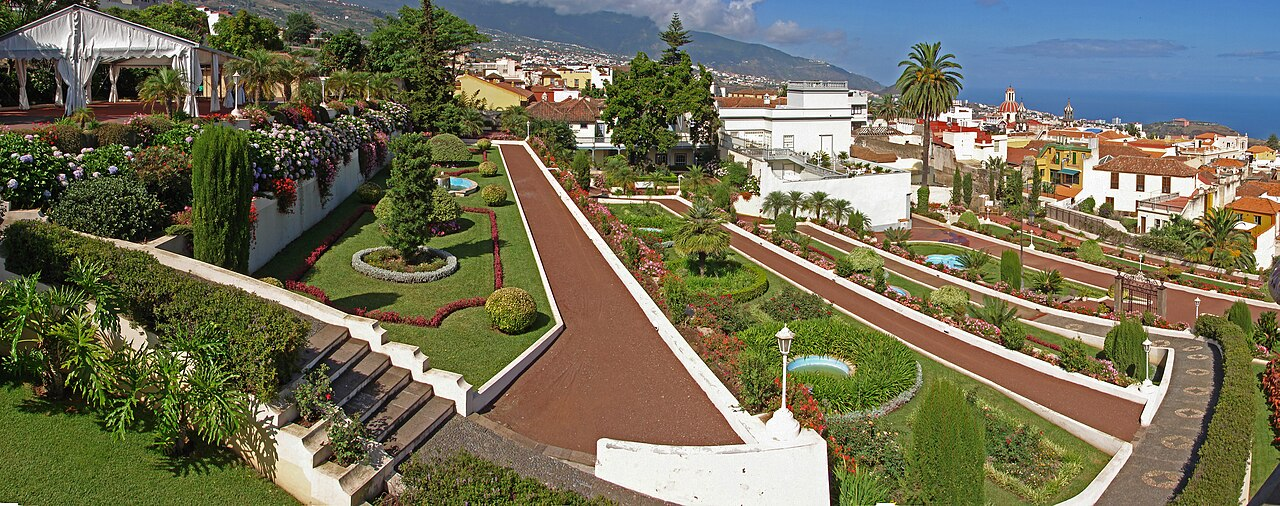
The first works began around 1790, and the first seedlings were planted in 1792. The space was designed on geometric principles, very characteristic of eighteenth-century botanical gardens: plants were not only to be grown but also organised, classified and observed. This way of planning reveals an essential idea — at that time the human being was seeking not only to admire nature but to understand it and arrange it into a system. Walking through the garden, then, it is worth seeing not only the exotic greenery but the very intention behind it: this was a place where nature was meant to become knowable, manageable and transferable.

The limits of empire and climate
One of the most interesting details of the garden's history is that its original purpose was not fully fulfilled. Tropical and subtropical species that thrived in Tenerife did not always adapt successfully to the inland mainland Spanish climate. In other words, the garden showed not only human ambition but also the limits of nature. Plants can be moved, but climatic realities cannot always be rewritten. Paradoxically, this partial failure increases the garden's value. It became not just an acclimatisation point but living proof that nature has its own logic, which does not always submit to political or scientific plans.

An exceptional location
Geographically the garden sits in an exceptional spot. The official ICIA page states that it is located at C/ Retama 2, Puerto de la Cruz, at roughly 110 metres above sea level. This position is crucial because it brings together several essential features of Tenerife: the mild Atlantic climate, the more humid environment of the northern side of the island and the closeness of the Orotava Valley. These conditions allowed the garden to function as an intermediate botanical laboratory between the tropics and Europe. Here, climate is inseparable from the garden's very essence. Founded somewhere else, its history could have been completely different.

Tamed but not sterile nature
And yet the value of this garden is not only scientific or institutional. It has a strong aesthetic and emotional pull. Unlike the wild landscapes of Anaga or Teide, the botanical garden offers tamed but not sterile nature. Here you feel that the plant life of the world has been gathered, concentrated and sheltered in one corner of the island. Palms, giant leaves, tropical species, shaded paths and a vertical layering of plants create the sensation that you are not only in Spain but in a much wider climatic world. It is one of those gardens you walk through not just in space but in the global imagination of botany.

A living scientific institution
What is particularly interesting is that the garden has retained its scientific function. Sources show that today it is linked to the Instituto Canario de Investigaciones Agrarias (ICIA), and its activity covers not only visits but research, a herbarium and scientific access by appointment. This is significant because the garden is not a historical relic. It is still a living space of knowledge. Such places carry a special value, since the past in them is not finished — it continues through ongoing research and conservation work.

What's in a name
Many visitors are surprised to learn that the "Garden of La Orotava" is actually located in Puerto de la Cruz. But this very confusion opens up an older geography of the island. Once, Puerto de la Cruz was known as Puerto de La Orotava, and the older name has remained. This detail is much more than an administrative quirk. It reminds us that place names on the islands preserve the maps of the past even when present-day boundaries shift. The garden's name itself becomes a small monument to history.
A protected historic landscape
The cultural significance of the garden is reinforced by its protected status. Sources mention that since 1994 it has held heritage status as a historic garden. This matters because what is being protected here is not only a plant collection. What is preserved is the very idea that a landscape can be a historical document. Just as an old town centre preserves urban memory, the botanical garden preserves a scientific, colonial, climatic and cultural memory.
Where Tenerife meets the world
One of the most beautiful ways to understand this garden is to see it as the place where Tenerife meets the world. The island is often presented through its volcanoes, beaches or mountains, but the botanical garden recalls another side of its identity: an intermediate stop between continents, climate zones and scientific traditions. The Americas, Europe, the tropics, the Atlantic and the Enlightenment all converge here. Few places can offer such a dense layering of meaning in such a calm, green space.
A garden to read slowly
This is why the garden deserves not a hurried visit but a slow reading. It is worth visiting not only with the eyes but with questions. Why did this garden appear precisely here? What does it say about eighteenth-century Spain? What does it reveal about climate, plant migration and scientific ambition? What does it mean that a place created to acclimatise foreign plants has itself become cultural heritage today? These are the questions that turn a visit from a pleasant outing into an experience that stays with you.
How to find the garden
The garden is located at C/ Retama 2, Puerto de la Cruz, on the northern side of Tenerife. Below is its exact location on the map.
Sources
- Instituto Canario de Investigaciones Agrarias (ICIA). "Jardín de Aclimatación de La Orotava — History." Official description of the garden's history: foundation in 1788, the decree of Charles III, the role of the Marquis Alonso de Nava y Grimón and its original acclimatisation purpose.
- Instituto Canario de Investigaciones Agrarias (ICIA). "Jardín de Aclimatación de La Orotava — Visitor Information." Official data on the location, address in Puerto de la Cruz, opening hours and current institutional management.
- Spain.info. "Tourism in La Orotava." General context on La Orotava, its historical and cultural importance in Tenerife.