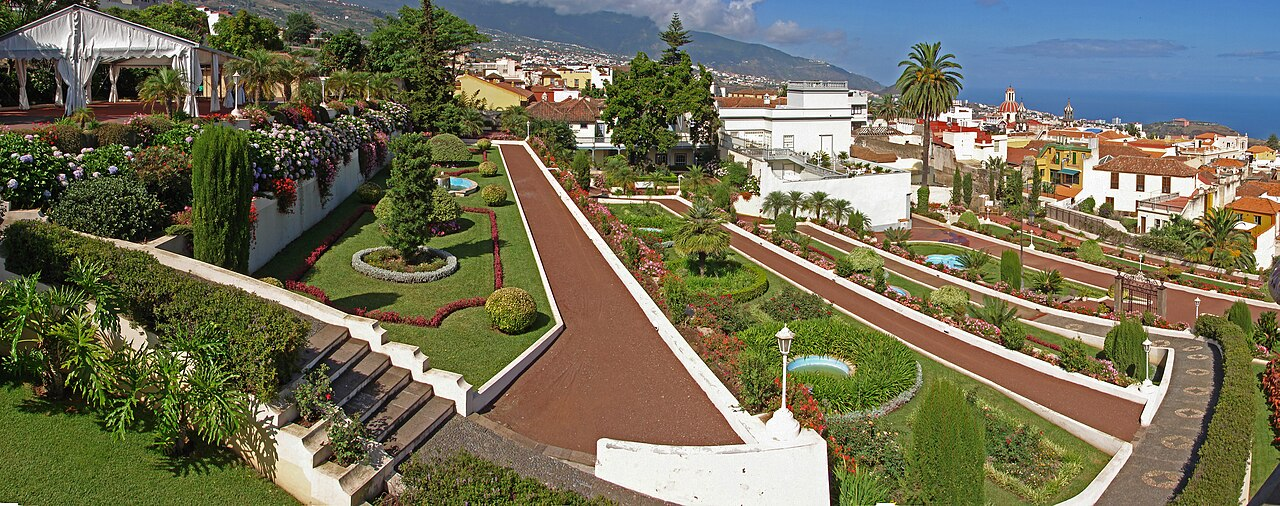
There are gardens created for beauty, and there are gardens created because beauty became the only language strong enough to answer pain. The Jardines del Marquesado de la Quinta Roja, also known as Jardín Victoria, belong to the second kind. At first glance, they seem serene: terraced greenery, meandering paths, clipped hedges, and one of the most elegant panoramic viewpoints in La Orotava. But this is not a garden whose meaning can be understood from a postcard. It is a place where landscape, architecture, grief, and ideology meet. To walk through it is to enter not only a carefully designed historic garden, but a chapter of Canary Islands history marked by social tension, religious power, and one family's attempt to transform exclusion into permanence.

The gardens originally formed part of the estate of the Marquisate of Quinta Roja and were attached to the family residence until the beginning of the twentieth century. Later, that residence was converted into the well-known Hotel Victoria, and both the hotel and gardens eventually became municipal property. This evolution already tells us something important. The site was never a random ornamental park. It belonged to a noble domestic setting and was conceived in relation to status, lineage, and architectural presence. Even today, the gardens retain that sense of composed dignity. They are not wild, nor are they grand in an imperial sense. Their power lies in ordered ascent, in how the terraces lead the eye and the body upward toward a structure that transforms the entire place from a pleasant garden into a symbolic landscape.

The Masonic Mausoleum at the heart of the gardens
That structure is the Masonic Mausoleum, the defining feature of the gardens and the reason this place is unlike any other in the Canary Islands. The official La Orotava tourism site describes the complex as a space of Masonic symbolism unique on the islands, formed by stepped terraces connected by winding paths, culminating in a mausoleum originally intended as a family pantheon. The ascending design is essential. These are not gardens to be viewed passively from a bench. They are meant to be experienced as a progression. Each terrace creates anticipation. Each turn of the path prepares the visitor for the monument above. The design gives physical form to remembrance: one climbs toward memory, toward conflict, toward the unresolved tension embodied in the mausoleum itself.

Grief that became architecture
The historical drama behind the mausoleum is what gives the gardens their unusual emotional force. The monument was promoted by the Marquise in order to house the remains of her son, Diego de Ponte del Castillo, the Marquis of Quinta Roja. According to the official site, the Church denied him burial because of his links to Freemasonry. That refusal transformed private grief into a public act of architectural resistance. Instead of accepting exclusion silently, the family commissioned a mausoleum that would stand as both memorial and statement. In this sense, the gardens are not only beautiful. They are polemical. Their very existence records a clash between ecclesiastical authority and a man whose affiliations placed him outside accepted religious norms of burial at the time.

This conflict cannot be understood without remembering the place of Freemasonry in nineteenth-century Spain. A historical note published by La Orotava explains that the local Taoro Lodge 90 was founded in 1874 and quickly entered into serious confrontation with ecclesiastical authorities. The mausoleum emerged from that atmosphere of tension. This matters because it shows that the monument is not an eccentric curiosity attached to a garden. It is the architectural trace of a real cultural battle over belief, social modernity, and the right to dignity in death. Gardens often symbolize peace, retreat, and order. Here, however, the garden also preserves dissent. It is a landscaped memory of intolerance and of the refusal to let that intolerance have the final word.
An architect, a marble, and a transnational message
The mausoleum itself was designed by the French architect Adolph Coquet, who was also a Freemason. Official La Orotava sources note that he conceived the building in an eclectic style infused with Masonic symbolism, and that it was made with marble from Lyon and completed in 1883. These details are important because they root the monument in an international cultural world rather than a purely local one. Freemasonry was a transnational network, and the mausoleum reflects that wider horizon. Its design does not belong solely to local religious or funerary tradition. It incorporates another symbolic language, one that would have been legible to initiates and provocative to opponents. In architectural terms, it is both memorial and coded declaration.

And yet, one of the most poignant facts about the monument is that it was never actually used as intended. The official La Orotava site states that although the mausoleum was built to receive the remains of Diego de Ponte del Castillo, it finally remained empty. Years later, his widow obtained permission from the bishopric to transfer his remains to the municipal cemetery instead. This detail gives the gardens their deepest emotional paradox. They culminate in a tomb without a body, in a pantheon that fulfilled its symbolic role more than its funerary one. The mausoleum therefore stands less as a burial place than as a monument against religious intolerance. It is memory without interment, mourning transformed into public form.
Reading the garden as a moral landscape
That is why the gardens deserve to be read not just visually, but morally and historically. Their terraces are beautiful, yes, but they are also part of a narrative of ascent toward a monument charged with absence. Their paths are elegant, but they lead to a structure built because institutional power denied a man burial in sacred ground. Their highest point offers remarkable views, but it also offers one of the most eloquent examples in Tenerife of how architecture can answer exclusion with dignity. This layered meaning is what makes the park unique. Without the story, it would still be lovely. With the story, it becomes unforgettable.

The physical design of the gardens reinforces this sense of layered significance. La Orotava's tourism descriptions emphasize the ascending terraces and the serpentine paths connecting them. This arrangement does more than organize a slope. It creates ceremony. The visitor is guided upward, almost ritually, until reaching the mausoleum. The journey becomes part of the meaning of the place. In landscape design, vertical movement often implies hierarchy, revelation, or transcendence. Here it also implies insistence: the memory at the top must be reached, must be approached, must not be ignored. The garden becomes an argument made in stone, greenery, and elevation.
From the gardens to Mount Teide
From the uppermost point, the gardens offer one of the most remarkable views in La Orotava. The official tourism text highlights the panorama extending from the town at sea level all the way up to Mount Teide at 3,718 metres. This is more than a scenic bonus. It gives the site another dimension of meaning. The gardens connect social history to geographical scale. From one terrace sequence, the visitor can read both the built order of the town and the volcanic magnitude that dominates Tenerife. It is as though the gardens place a human story of exclusion and remembrance inside the much larger physical story of the island itself. The result is a powerful contrast between intimate grief and immense landscape.

The connection to the former Hotel Victoria also adds depth to the site. Because the gardens once belonged to the noble residence later converted into that hotel, they occupy an interesting intersection of private aristocratic space, public memory, and civic heritage. Few gardens move through so many identities while keeping their symbolic center intact. What began as part of a marquis's domain became a public place where anyone can now encounter the history embedded in it. The democratization of access changes the meaning of the gardens again. They are no longer a family setting. They are now a civic landscape in which a once-contested memory has become part of collective heritage.
Why this site stands apart
In the broader context of La Orotava, the Quinta Roja gardens stand apart from the town's churches, balconies, convents, and traditional Canarian mansions because they introduce a different emotional register. Much of La Orotava's historic center communicates continuity, craftsmanship, and urban grace. Jardín Victoria introduces tension. It reminds the visitor that beauty in historic towns is not always innocent. Sometimes it is born from conflict. Sometimes the most graceful places carry the sharpest stories. The mausoleum above the terraces does not let the visitor remain in purely decorative admiration. It asks for interpretation. It asks for memory. It asks, in its quiet way, what societies do with those they choose to exclude.

There is also something profoundly modern about the message the site carries today. Although the historical dispute belongs to the nineteenth century, the core issue feels uncomfortably contemporary: who is allowed dignity, whose beliefs are tolerated, and how institutions react when a person does not fit accepted categories. The official description explicitly frames the mausoleum as a monument against religious intolerance. That phrase gives the gardens a significance that extends far beyond local tourism. They become a place where architecture preserves an ethical lesson. The visitor does not need to know every detail of Masonic history to feel the force of the site. The story is ultimately universal: a family confronted exclusion and answered it by creating a place of extraordinary grace.
This is why the Jardines del Marquesado de la Quinta Roja should not be approached as simply another attractive stop in La Orotava. They are a rare example of a historic garden whose beauty is inseparable from its symbolic purpose. They unite landscape design, funerary architecture, family history, ideological conflict, and panoramic geography in one compact but deeply resonant place. They reward visitors who look beyond surface charm and ask what a garden can mean when it is shaped not only by aesthetics, but by memory and conviction.
In the end, Jardín Victoria remains one of the most singular places in Tenerife because it shows how a landscape can become a statement. Its terraces soften grief without erasing it. Its paths transform a climb into reflection. Its mausoleum turns absence into presence. And its views over La Orotava and toward Teide place a human conflict within the wider grandeur of the island. That is why this park lingers in the mind. It is not just pretty. It is meaningful. And that is far rarer.
How to find it
Sources
- Ayuntamiento de La Orotava. "Marquisate of Quinta Roja Gardens. Masonic Mausoleum." Turismo de La Orotava.
- Ayuntamiento de La Orotava. "Victoria Gardens / Masonic Mausoleum / Quinta Roja Pantheon." Turismo de La Orotava.
- Ayuntamiento de La Orotava. "Jardines del Marquesado de la Quinta Roja." Turismo de La Orotava.